
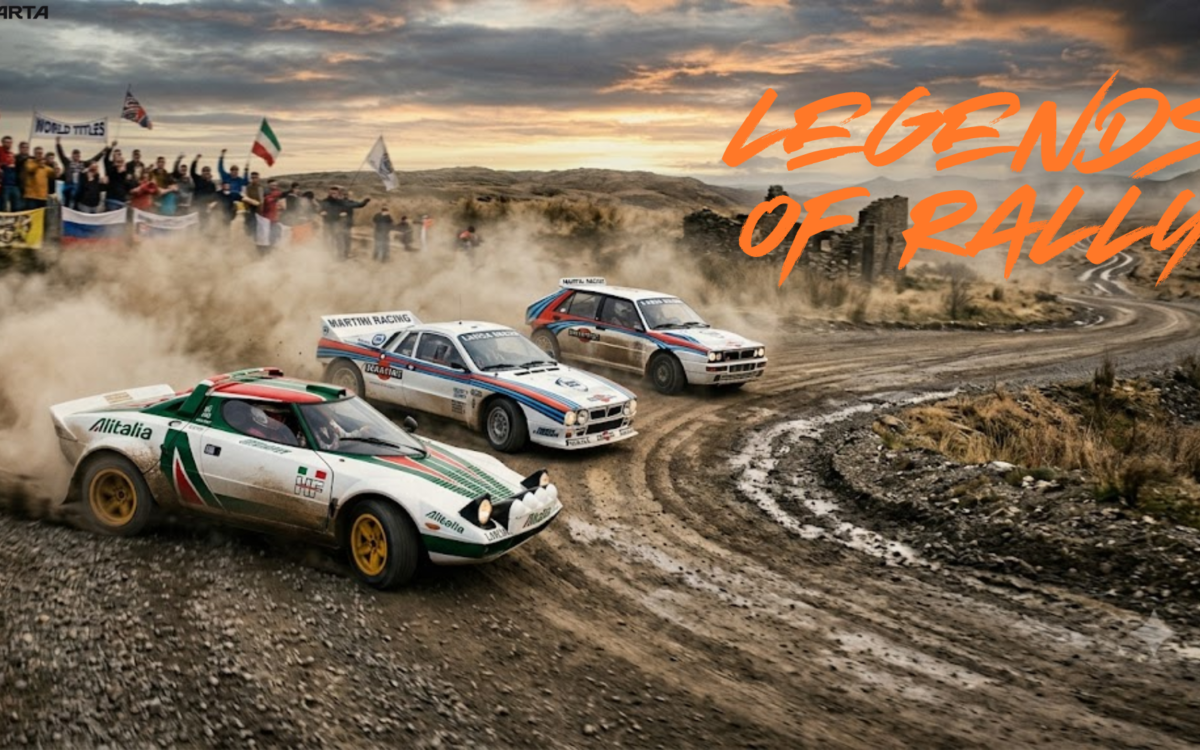
In the final decades of the 20th century, rally racing—especially the legendary Group B and Group A eras—served the ultimate crucible of motorsports. And no manufacturer dominated this golden age quite like the plucky legends from Italy, Lancia with 10 World Rally Championships.
This Italian marque was armed with radical engineering and an unmatched tactical ability to find genius loopholes. That resulted in Lancia cars clinching a record 10 Manufacturers’ Championships between 1974 and 1992, routinely humiliating industry giants.
Yet today, that racing empire has virtually vanished from the global stage. Lancia’s collapse offers a defining corporate case study. Winning on the track means nothing if corporate mismanagement, cost-cutting, and brand dilution rot the showroom floor.
So how did the most dominant rally empire in motorsport history end up reduced to a single, badge-engineered city car sold only in Italy?
Lancia Stratos to 037: The Wedge, the Rulebook, and the Masterclass
Lancia didn’t adapt to rally racing; it forced the sport to adapt to Lancia. In the early 1970s, rally grids were populated by modified family road cars. Lancia shattered that convention by developing the Stratos HF—the first purpose-built rally weapon in motorsport history.

Lancia Stratos was a Bertone-designed fiberglass wedge, featuring a mid-mounted Ferrari Dino V6 engine. With the iconic Alitalia livery, it turned rallying from an amateur test of endurance into a technical sprint, capturing three consecutive World Rally Championships (1974–1976).
But then came Audi with its All-Wheel-Drive Quattro in the early 1980s, declaring RWD monsters obsolete. What followed, though, was a masterclass in tactical warfare under team principal Cesar Fiorio, which will be remembered for ages to come.
Understanding that the 037 was lighter and more agile on tarmac, Fiorio turned the rulebook into a competitive weapon.
The Homologation Bluff
In the 1980s, the FIA mandate on legendary Group B regulations required the manufacturers to produce 200 road-legal units of their race cars.
Rather than complying with the mandate, Fiorio and the Lancia team showed a never since repeated loophole ingenuity.
Fiorio showed the FIA inspectors 100 road-legal cars in one parking lot and then treated them to a lavish Italian lunch. Meanwhile, the team drove those same 100 cars across town to a second parking lot and then had the FIA people inspect these cars as the “second batch”.
So they got away with just producing 100 road-legal units.
The Monte Carlo Icy Pavements
Monte Carlo was the season opener in the 1983 Group B World Rally Championships season. But the snowy alpine corners of this track had become too slippery for the rear-wheel-drive 037’s high-grip slicks. That meant Audi Quattro’s all-wheel drive system would perform much better.

But that wasn’t going to deter the Lancia team. Fiorio secretly arranged for salt to be spread over the snowy alpine corners. It eliminated the ice, so the 037s could get enough grip, which meant Walter Rohrl went on to win this opening round.
Tactical Delays in Greece
We got to see another display of tactical brilliance from Lancia in Greece. The Italians understood early on that Audi had a leg up in the low-traction dirt tracks with its AWD Quattros, and Greece with its dust-choked stages was going to be a goldmine for them.

Obviously, they couldn’t do anything about the traction like Monte Carlo. But a little clearer visibility would always be helpful. So the Lancia crews deliberately stalled their cars at the start line to allow visibility to clear before launching.
Needless to say, Lancia’s gambles and antics paid off. The 037 defeated Audi’s four-wheel-drive juggernaut to claim the 1983 Manufacturers’ World Championship.
Lancia 037 remains the final two-wheel-drive car ever to win the World Rally Championship. It set the benchmark in how lean, agile teams can outmaneuver technologically superior rivals through pure strategic execution.
Lancia Delta: From Group B Tragedy to an Untouchable Six-Title Monopoly
By the mid-1980s, Group B had evolved into an unrestricted engineering arms race. To remain at the cutting edge, Lancia engineered the Delta S4, which was a technical marvel in a true sense. It solved turbo lag by deploying both a volumetric supercharger for instant low-end torque and a massive turbocharger for top-end power.
The Lancia Delta S4 weighed just around 890 kg and produced upwards of 500 to over 700 horsepower. There’s even a myth that this legend with 0-60 mph time of just 2.5 seconds (on loose gravel) could go toe-to-toe with the 1980s Formula 1 cars. That makes it a legend and equally as terrifying, and for good reason.
Its bodywork was made with lightweight composite materials, and the fragile fuel cells meant it could go up in flames during high-impact crashes.
Following the fatal crash of Henri Toivonen and Sergio Cresto at the 1986 Tour de Corse, the FIA abruptly banned Group B, resetting global regulations overnight.

Rival manufacturers were left scrambling by the sudden regulatory pivot to production-based Group A machinery. Lancia, though, showed an unmatched display of operational agility.
Rather than starting from scratch, Lancia rapidly adapted its existing family hatchback into a purpose-built competition platform. The result was Lancia Delta HF 4WD, and its evolution into the wide-arched Delta Integrale. The Lancia Delta unleashed the most dominant winning streak in motorsport history.
The Six World Rally Championships Monopoly
Between 1987 and 1992, Lancia captured six consecutive World Rally Manufacturers’ Championships. It won 46 WRC rallies and four Drivers’ titles with legends like Juha Kankkunen and Miki Biasion.
The Homologation Blueprint
Lancia turned the boxy, road-going Delta into a high-performance icon draped in the iconic Martini livery. The Italian brand created the modern template for rally homologation specials long before the Subaru WRX or Mitsubishi Lancer Evolution emerged.

The Lancia Delta Integrale established an untouched global benchmark. Yet, this peak on the world’s gravel stages masked an escalating structural crisis occurring behind the showroom doors.
The Showroom Reality: Rust, Bureaucracy, and the Fiat Trap
While Lancia engineers were building bulletproof rally machines on the weekends, the road cars arriving in dealer showrooms told a catastrophic operational story.
The disconnect stemmed from Lancia’s acquisition by Fiat in 1969. While the buyout injected much-needed capital, it also subjected the bespoke engineering house to corporate cost-cutting, bureaucratic inertia, and severe manufacturing compromises.
The tipping point arrived with the launch of the Lancia Beta in the mid-1970s. Designed to be a high-volume executive model, the Beta was manufactured using low-grade, thin-gauge sheet steel—sourced in part from the Soviet Union as part of a trade agreement. The consequences for quality control were disastrous.

Structural Corrosion
Unprotected body panels and untreated hollow sections meant cars were rusting within months of leaving factory floors. In severe cases, structural subframes rusted through and detached from the chassis under basic load.
The Media Backlash
Following intense investigative coverage by the British press and consumer programs, Lancia’s brand equity collapsed overnight in key export markets.
The Buyback Debacle
Fiat was forced into an unprecedented recall program, spending millions to repurchase thousands of rotting Betas directly from consumers only to crush them into scrap metal.
The damage proved irreversible. Lancia had spent decades cultivating a reputation for aristocratic craftsmanship and avant-garde mechanical engineering. They introduced the world’s first production monocoque chassis, the first production V6 engine, and independent suspension systems.
In less than a decade, that prestige was replaced by a widespread consumer perception that Lancias were fragile, poorly assembled, and inherently unreliable. Even the road-going Delta Integrale, celebrated for its razor-sharp dynamics, was plagued by brittle interiors, electrical gremlins, and cracking chassis under heavy use.
Lancia had built an unshakeable motorsport myth, but it had entirely lost the trust of the everyday car buyer.
Fun Fact
Today, Lancia Delta Intergrale enjoys a massive cult following and is still revered as one of the greatest hot hatchbacks and rally cars of all time.
Final Blow: Lancia’s Slow Suffocation into Irrelevance
By the early 1990s, Lancia stood at a crossroads. Having conquered rallying with six consecutive titles, the brand needed a clear corporate identity to justify its expensive motorsport program. Instead, parent company Fiat made a series of strategic miscalculations that stripped Lancia of its defining purpose.
Abandoning the Rally DNA (1992)
Facing rising competition costs and declining road car sales, Fiat abruptly pulled Lancia out of the World Rally Championship after the 1992 season. Overnight, the marque lost its strongest marketing asset and the primary reason car enthusiasts bought its vehicles.
The Identity Crisis and Failed Repositioning
Fiat management decided Alfa Romeo would become the group’s “sporty” brand, while Lancia was rebranded as “luxurious and comfortable.” This forced pivot alienated Lancia’s loyal, performance-focused fanbase. Instead of sharp, aggressive homologation specials, showrooms were filled with soft, uninspired sedans like the Thesis that struggled to compete with German rivals.
The Rebadged Chrysler Debacle (2011)

The lowest point came following the Fiat-Chrysler merger. Lancia should have developed genuine Italian luxury cars. But instead, under Fiat management, they took American models—like the Chrysler 300 sedan and Chrysler Voyager minivan—slapped Lancia badges on the grilles, and sold them across Europe.
And on top of this enthusiast misjudgement, the build quality remained questionable, which meant the sales plummeted.
The Retreat to a Single Market (2017)
By 2017, Stellantis (formerly FCA) had pulled Lancia out of every international market. The once-mighty manufacturer was reduced to selling a single vehicle—the Ypsilon city car—exclusively within Italy.
In a matter of three decades, the most dominant motorsport empire in rally history had been systematically stripped of its racing heritage, its global distribution, and its engineering autonomy.
Lancia’s Latest Spark of Revival
For years now, automotive enthusiasts, like myself, have been speaking of Lancia in high praise, but in the past tense. But the story hasn’t really reached its final chapter.
Under the stewardship of Stellantis, Lancia has been granted a ten-year strategic funding window, a complete product reboot, and a roadmap to re-enter the mainstream European market.
Global Expansion with Multi-energy Platforms
Rather than lingering as an Italian domestic curiosity, Lancia has initiated an ambitious international comeback. The spearhead is the all-new Ypsilon, built on modern multi-energy and electric platforms, accompanied by a phased return to key European dealer networks outside Italy.
The Return of HF and Red Elephant
For Motorsport purists, a credible revival of Lancia must acknowledge its performance roots. So the brand has resurrected the iconic HF (High Fidelity) designation and its legendary “Little Red Elephant” logo.
Lancia’s modern hot-hatch iterations have been designed and outfitted with widened tracks, lowered suspension, and potent electric powertrains to capture the spirited ethos of the Integrale.
The Rally Testing Ground: Rally4 and Beyond
Most importantly, Lancia has dipped its toes back into the world that made it immortal: rallying. The brand has launched its customer-competition programs with the Ypsilon Rally4 HF. With that, it’s deliberately rebuilding its competitive pedigree from grassroots motorsport upward.

While not a full-scale factory assault on the top-tier WRC just yet, it signals that the brand has finally remembered where its soul belongs.
So What’s the Final Takeaway on Lancia?
Lancia’s twentieth-century narrative remains one of automotive history’s greatest cautionary tales. It shows that motorsport supremacy alone cannot save a carmaker from compromised build quality, uninspired product planning, and eroded brand identity.
Yet, as the industry transitions into a new technological epoch, Lancia has restarted with a rare clean slate. But whether this modern revival can recapture the magic of the Stratos, 037, and Delta remains to be seen.
But for the first time in over thirty years, the most legendary name in rally history is looking toward the road ahead, rather than just the trophy cabinet behind.
Any true petrolhead will be looking forward to Lancia’s return. And can I just say that the Lancia 037 and the Lancia delta Integrale are two of my favorite cars ever and I would like to be their proud owner someday.
Follow along with Carvarta for more cool feature stories from the car industry. Lancia for the win!